Local retailers need e-commerce, so let’s give it to ’em

A recent email from Internet Retailer grabbed my attention.
Its purpose was to plug their new annual Top 500 Guide — a huge directory packed with stats on who’s big in e-commerce, who’s growing market share and who’s not.
But what caught my eye was their take on what’s new in the data.
For years, it said, previous guides had shown big-box stores getting drubbed in e-commerce sales by web-only e-tailers.
“But,” the email said, “…that began changing in 2013, when the chains closed the gap by growing their online sales by 16.7%, taking market share away from manufacturers and catalogers…. Read the rest of this entry
The hardest part of saving news: Changing the definition
Lots of people understand that the traditional business model around news is breaking down. Far fewer realize it’s not just the business part — advertising — that’s broken. It’s also news itself.
Why is this so hard to understand?
A planet full of people is going from a daily diet of a newspaper and a couple of news broadcasts to constant access to almost everything there is to know. Inevitably, this is causing people today to want and expect different things from their time spent on content than people did 20 or 50 years ago.
But what we produce as news has hardly changed. Read the rest of this entry
Content marketing: Time to jump on the opportunity
 Infinite bandwidth.
For those of us in traditional media, it’s the source of our problems, and it’s also the uncharted space of our new opportunities.
With bandwidth rising toward infinity and costs falling to near zero, it’s enabling all sorts of new content models to eat our lunch. “Free” digital bandwidth has enabled all of our disrupters, from early ones like Craigslist and Facebook and to newer ones like BuzzFeed, Instagram and SnapChat. And more will keep coming. Read the rest of this entry
Millennials, news and the Borneo effect
It’s the Year of the Millennials, according to Pew. In 2015, at ages 18 to 34, they will surpass Baby Boomers in the U.S. to become the largest living generation. And a major new report by the Media Insight Project, just released at the NAA mediaXchange, sheds a lot of new light on their consumption of news.
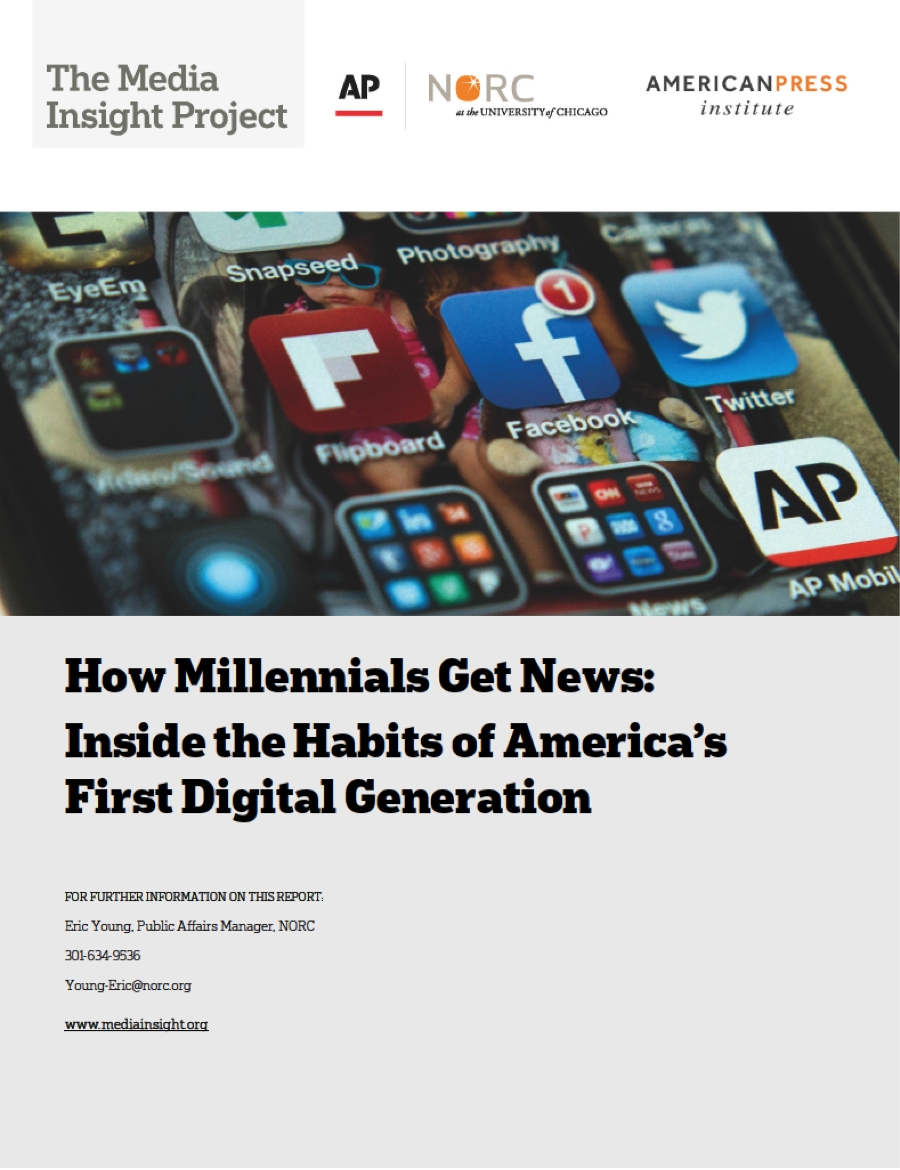 The report (pdf, html) emphasizes the bright side, stressing the finding that most Millennials do value news and consume it regularly. But the most worrisome finding for newspaper companies is that they rarely go to traditional news providers to get it. We are far back in the loop, when we’re in it at all. Read the rest of this entry
The audience game is forever changed; will we change, too?
Media folks, can we all agree on this statement?
- We’re in the audience business.
If you disagree, we need to talk, and we’ll do that in a minute.
But first, here’s the nut graf:
As an audience business, we’re overdue for a drastic rethink of what we do. Too often, we’re still doing 20th-century audience thinking amid the starkly different realities of the 21st century. We’re getting pounded on the audience front, and we have to figure out what audience strategies will work in this new environment. Read the rest of this entry
Local media need to join the fight for in-store traffic
In the local media business, whatever hurts retailers hurts us, too. They’re feeling a big hurt right now, and we need to help them fight back.
That big hurt is a steady and continuous decline in store traffic. This means loss of sales, and that leads nowhere good for them — or for local media.
Three values crucial to your disrupted business
 When your business is undergoing major disruption and must change direction, how do you get people on board? How do you win hearts and minds to the new strategies needed to survive and thrive?
How to change behavior in your disrupted organization
 When a company or industry is beset by massive disruption — as the traditional media have been for more than a decade now — it creates two massive challenges:
- Figuring out how the business has to change.
- Changing behaviors in the organization to get the new things done.
As most people in the newspaper industry can testify, both of these are difficult and relentless. There’s no “one and done” in a disruption as massive as the digital revolution.
And, unfortunately, success at No. 1 is no guarantee of success at No. 2.
Over last three years, I’ve blogged frequently about No. 1. This time let’s look at No. 2. Read the rest of this entry
The local media company of the future: Selling what, and selling how?
What does the local media company of the future look like?
At this point, the answer is pretty clear. There will be two kinds of media companies:
- Those that continue to focus on their traditional media channels — newspaper, broadcast television channel, radio station(s) — and therefore shrink along with the advertising spending on those media.
- Those that morph into local media houses that can connect any advertiser with any audience, through platforms, technologies and channels they own or don’t, to win dollars that are moving into digital advertising and marketing.
 MediaReset